Patrick Gracewood
Sculpture is the art form that best deals with eternity and mortality; it lasts for centuries. Most of what we know of the deep past is sculpture, from graves both personal and cultural.
I love art of the ancient world, my own work collapses the time between then and now. An Ancient Egyptian cell phone? A 'newly discovered' Tang Dynasty reliquary? No problem for my imagination.
Professionally, I made sculpture for film, tv, the display industry, and architectural restoration. All the film work went into the dumpster at the end of filming. Creating sculpture for historic restoration and new construction was satisfying, because it lasts. Recreating architectural ornamental sculpture influenced my own fine art, philosophically and technically, but I never expected to integrate its symbols into my own work. To my surprise, they bring their own depth and meaning to my art.
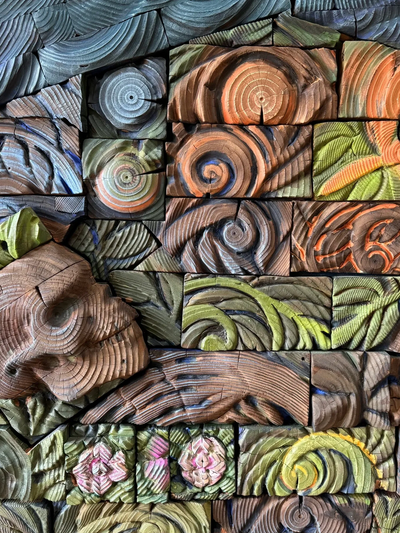
The focus of my art is the human experience of time and mortality. Wood, my chosen medium, records and reveals its history, much as we do. My approach is to use wood, its knots, checks, weathering, for its inherent beauty and as metaphor for the human condition. Each block of discarded construction material becomes a pixel of information.
I use the annular growth rings as compositional lines. Each line equals one year of growth. Each set of concentric rings is the heart of a tree. I’m drawing with time; the viewer is looking at a story but also looking into recorded time
My objective is that the viewer engage with the story of the sculpture and simultaneously witness time itself, creating an experience that is both cognitive and somatic.